C++: random number generator
An out-of-box header-only C++ random number generator class that can generate uniformly or normally distributed random numbers (integer or floating points), one at a single call; only the standard library is used.
Refs: [1], [2], [3], [4].
A minimum prototype
Listing 1: A minimum prototype of a random number generator in C++.
// prototype.cpp
#include <iostream>
#include <random>

using SeedType = std::random_device::result_type;

// #include <cstddef>
// #include <cstdint>
// #include <limits>
// void test_random_device()
// {
//     std::random_device rd {};

//     std::cout << "Entropy: " << rd.entropy() << "\n\n"; // 如果返回 0 则说明这是伪随机数,> 0 则是真随机数
//     std::cout << "Min value: " << std::numeric_limits<SeedType>::min() << "\n";
//     std::cout << "Max value: " << std::numeric_limits<SeedType>::max() << "\n\n";

//     std::cout << "Max value of int: " << std::numeric_limits<int>::max() << "\n";
//     std::cout << "Max value of long: " << std::numeric_limits<long>::max() << "\n";
//     std::cout << "Max value of long long: " << std::numeric_limits<long long>::max() << "\n";
//     std::cout << "Max value of std::int32_t: " << std::numeric_limits<std::int32_t>::max() << "\n";
//     std::cout << "Max value of std::int64_t: " << std::numeric_limits<std::int64_t>::max() << "\n";

//     std::cout << "Max value of unsigned int: " << std::numeric_limits<unsigned int>::max() << "\n";
//     std::cout << "Max value of unsigned long: " << std::numeric_limits<unsigned long>::max() << "\n";
//     std::cout << "Max value of unsigned long long: " << std::numeric_limits<unsigned long long>::max() << "\n";
//     std::cout << "Max value of std::uint32_t: " << std::numeric_limits<std::uint32_t>::max() << "\n";
//     std::cout << "Max value of std::uint64_t: " << std::numeric_limits<std::uint64_t>::max() << "\n";
//     std::cout << "Max value of std::size_t: " << std::numeric_limits<std::size_t>::max() << "\n";
// }

// 生成服从正态分布的 double 随机数的 function object (functor)
class RandNormal {
public:
    // 真随机数生产成本太高,因此我们以真随机数(但不同平台不一样,有的平台 random_device 生成的也是伪随机数)为种子,批量生产伪随机数
    RandNormal(double mean, double stddev) : dist {mean, stddev} { re.seed(std::random_device {}()); } // 用 random_device 生成一个真随机种子
    RandNormal() : RandNormal(0.0, 1.0) {} // 默认构造函数:均值为 0,标准差为 1
    double operator()() { return dist(re); } // 播种后的引擎可以高效地产生伪随机数,dist 进而将其映射到正态分布
    // 这样定义以后,我们在使用时就可以通过 function call () 访问随机数
    template <typename IntegerType>
    void seed(IntegerType s) { re.seed(static_cast<SeedType>(s)); } // 允许人为指定种子,便于复现随机数序列
private:
    std::mt19937 re {}; // 将 梅森绞扭器 (Mersenne Twister) 作为随机数引擎
    std::normal_distribution<RealType> dist { 0.0, 1.0 }; // 正态分布
};

// 关于 梅森绞扭器 (Mersenne Twister):
// The internal state of a Mersenne Twister requires 19937 bits (2493 bytes), which is 624 32-bit values or 312 64-bit values.
// As a result, std::mt19937 allocates 624 integers, whereas std::mt19937_64 allocates 312 integers.
// * The integers allocated by std::mt19937 are defined to be of type std::uint_fast32_t, which could be 32-bit or 64-bit integers depending on the architecture.
// * If std::uint_fast32_t resolves to a 64-bit integer, std::mt19937 will use 624 64-bit integers, making it double the size it needs to be.
// In the examples above, the seed is only a single integer. This means we’re essentially initializing 624 integers using a single integer, which is significantly underseeding the Mersenne Twister PRNG.
// std::seed_seq is a type that was designed to help with this. We can pass it as many randomized values as we have, and then it will generate as many additional unbiased seed values as needed to initialize a PRNG’s state.
// If you initialize std::seed_seq with a single value (e.g. from std::random_device) and then initialize a Mersenne Twister with the std::seed_seq object, std::seed_seq will generate 623 values of additional seed data. This won’t add randomness, but it will give us a better mix of 0 and 1 bits.
// However, the more random data we can provide std::seed_seq, the better job it will do for us. So the easiest idea is to simply use std::random_device to give std::seed_seq more data to work with.
// If we initialize std::seed_seq with 8 values from std::random_device instead of 1, then the remaining values generated by std::seed_seq should be much better.


int main()
{
    // test_random_device(); // 测试 random_device 的熵和 result_type

    RandNormal rng {}; // 像定义变量一样定义一个随机数生成器对象 r

    for (int i = 0; i < 10; ++i) {
        std::cout << rng() << "\n"; // 通过 function call () 访问随机数
    }

    return 0;
}
The header file
Listing 2: The class.
// random_number.hpp
#if !defined(RANDOM_NUMBER_HPP)
#define RANDOM_NUMBER_HPP

#include <chrono> // for std::chrono::high_resolution_clock
#include <cstddef> // for std::size_t
#include <optional> // for std::optional<>;optional 通过解引用 * 或 .value() 访问值,std::nullopt 表示无值
#include <random>
#include <stdexcept> // for std::invalid_argument
#include <type_traits> // for std::is_arithmetic_v<>, std::is_integral_v<>, std::conditional_t and std::is_floating_point_v<>
#include <vector> // 保存种子序列

namespace random_number_generator {
    // 能够从本头文件直接获取的分布类型
    enum class MyDistributionType {
        uniform,
        normal
    };

    using SeedType = std::random_device::result_type; // 用 random_device 产生种子
    // using SeedType = Engine::result_type; 也行,并且似乎更合理一些

    // 思考:能不能为 RandUniform 和 RandNormal 建立一个父类?建立父类有意义吗?

    // 理论上可以用均匀分布生成任意分布(涉及反函数,见概率论教材)
    // 生成服从均匀分布的随机数
    template<typename T = double, typename Engine = std::mt19937_64> // 模板参数:T 是生成的随机数类型,Engine 是随机数引擎类型
        requires std::is_arithmetic_v<T>&& std::uniform_random_bit_generator<Engine> // 要求 T 是算术类型(整数或浮点数),Engine 是符合概束 uniform_random_bit_generator 的随机数引擎
    // 概束 uniform_random_bit_generator<G> 指定了 G 是一种均匀随机比特生成器类型,也就是说,类型 G 的对象是一个函数对象 (function object, functor),它返回 SeedType,使得在可能结果范围内的每个值都具有(理想上)相等的返回概率
    class RandUniform {
    public:
        // 便于外部使用的数据类型别名
        using ValueType = T;
        // 便于外部使用的随机数引擎类型别名
        using EngineType = Engine;

        // 根据 T 的类型选择整数分布或实数分布
        using DistributionType = std::conditional_t<
            std::is_integral_v<T>,
            std::uniform_int_distribution<T>,
            std::uniform_real_distribution<T>
        >;

        // 统计信息使用的浮点类型(即,若 T 为整数则使用 double)
        using RealType = std::conditional_t<std::is_floating_point_v<T>, T, double>;

        // 状态结构体
        struct State {
            Engine re {}; // 随机数引擎
            T low { static_cast<T>(0) }; // 区间左端点
            T high { static_cast<T>(1) }; // 区间右端点
            DistributionType dist { static_cast<T>(0), static_cast<T>(1) }; // 均匀分布:默认为 [0.0, 1.0) 或 [int(0), int(1)] 上的均匀分布
            std::vector<SeedType> current_seed {}; // 当前种子序列
            std::size_t count { 0 }; // 已经生成了的随机数数目:是否有必要记录?
            std::optional<T> current_value { std::nullopt }; // 当前(或者说,上一个)随机数取值;optional 通过解引用 * 或 .value() 访问值,std::nullopt 表示无值
            // 是否要维护以下变量取决于目的:如果只是大批量生成随机数,则不需要维护 sum 和 sum_sq;如果要统计均值和方差,则需要维护 mean 和 sum_Welford —— 可以考虑写一个子类,把统计信息的维护放在子类中
            RealType mean { static_cast<RealType>(0) }; // 已经生成的随机数的均值,用于计算均值
            RealType sum_Welford { static_cast<RealType>(0) }; // 已经生成的随机数的 Welford 算法中的 M2,用于计算方差
        };

        // ---------- 构造函数 ----------
        // 允许用户指定分布区间 [low, high)
        // 若不指定 low 则默认为 [0, high)
        // 若都不指定则默认为 [0, 1)
        // 对整数为闭区间
        RandUniform(T low, T high) { reset(low, high); }
        explicit RandUniform(T high) { reset(static_cast<T>(0), high); }
        RandUniform() { seed(); }

        // 允许从状态结构体构造对象,便于从保存的状态直接恢复;explicit 避免隐式转换
        explicit RandUniform(const State& state)
            : current_state { state }
        {
            if (current_state.low > current_state.high) throw std::invalid_argument("Uniform distribution requires low <= high.");
            if (current_state.current_seed.empty()) seed(); // 若没有种子则用 random_device 生成一个随机种子;注意 seed() 中调用了 reset_state() —— 由于原本就没有种子,我们直接造一个新的即可
        }

        // ---------- 通过 function call () 访问随机数 ----------
        virtual T operator()() noexcept
        {
            T temp { current_state.dist(current_state.re) }; // 摇一个随机数,保存到临时变量 temp 中
            current_state.current_value = temp; // 更新 current_value
            ++(current_state.count); // 计数器加一
            RealType n = static_cast<RealType>(current_state.count);
            RealType delta = static_cast<RealType>(temp) - current_state.mean;
            current_state.mean += delta / n;
            current_state.sum_Welford += delta * (static_cast<RealType>(temp) - current_state.mean); // 这里用的是 Welford 算法,避免了数值不稳定性

            return temp;
        }

        // ---------- 状态查询 ----------
        // [[nodiscard]] 表示调用者不应忽略返回值;noexcept 表示函数不会抛出异常;被标记为 const 的函数不会修改调用它的对象 (即 *this, this 指针指向的对象) 的状态

        [[nodiscard]] const State& get_current_state() const noexcept { return current_state; } // 返回当前状态结构体
        [[nodiscard]] T get_low() const noexcept { return current_state.low; } // 返回当前分布区间的左端点
        [[nodiscard]] T get_high() const noexcept { return current_state.high; } // 返回当前分布区间的右端点
        [[nodiscard]] const auto& get_current_distribution() const noexcept { return current_state.dist; } // 返回当前分布
        [[nodiscard]] const std::vector<SeedType>& get_current_seed() const noexcept { return current_state.current_seed; } // 返回当前种子;有可能为空
        [[nodiscard]] std::size_t get_count() const noexcept { return current_state.count; } // 返回已经生成的随机数数目
        [[nodiscard]] std::optional<T> get_current_value() const noexcept { return current_state.current_value; } // 返回当前(或者说,上一个)随机数取值

        // ---------- 统计信息 ----------

        // 样本均值
        [[nodiscard]] RealType get_sample_mean() const noexcept {
            return current_state.count > 0 ? current_state.mean : static_cast<RealType>(0);
        }
        // 样本方差(除以 N - 1)
        [[nodiscard]] RealType get_sample_variance() const noexcept
        {
            if (current_state.count < 2) return static_cast<RealType>(0);
            return current_state.sum_Welford / static_cast<RealType>(current_state.count - 1);
        }

        // ---------- 状态修改 ----------

        // 将已有状态载入当前变量;不自动播种,保持所加载的引擎的状态
        void load_state(const State& state)
        {
            if (state.low > state.high) throw std::invalid_argument("Uniform distribution requires low <= high.");
            current_state = state;
            // 不自动播种,保持所加载的引擎的状态
        }
        // Other things that are sometimes used include the current thread id, the address of particular functions, the user’s id, the process id, etc… See randutils.hpp.
        // 用当前时间和包含 7 个 random_device 随机数的 seed_seq 播种
        void seed()
        {
            std::random_device rd {};
            std::vector<SeedType> seeds {
                static_cast<SeedType>(std::chrono::high_resolution_clock::now().time_since_epoch().count()),
                rd(), rd(), rd(), rd(), rd(), rd(), rd()
            };

            std::seed_seq ss(seeds.begin(), seeds.end());
            current_state.re.seed(ss);

            std::vector<SeedType>().swap(current_state.current_seed); // 清空当前种子
            current_state.current_seed = std::move(seeds);

            reset_state(); // 注意:播种时将所有状态都初始化了
        }

        // 用任意数目的 SeedType 序列播种,同时保存该序列供 reset() 复现(为便于复现,这时种子不包含当前时间)
        void seed(std::vector<SeedType> seeds) // 这里必须传递 copy, 否则以 current_seed 为 seed 会先清空 current_seed
        {
            if (seeds.empty()) {
                seed();
            } else {
                std::seed_seq ss(seeds.begin(), seeds.end());
                current_state.re.seed(ss);

                std::vector<SeedType>().swap(current_state.current_seed); // 清空当前种子
                current_state.current_seed = std::move(seeds);
                reset_state();
            }
        }

        // 用任意数目的非负整数序列播种的便捷变参形式:seed(4638, 1169, 5752, ...)
        template<typename... IntegerType>
            requires (std::is_integral_v<IntegerType> &&...)
        void seed(IntegerType... seeds) {
            if constexpr (sizeof...(seeds) > 0)
            {
                seed(std::vector<SeedType> {static_cast<SeedType>(seeds)...});
            } else {
                seed();
            }
        }

        // 不改变任何参数,将随机数发生器恢复到初始状态(引擎和种子的状态都一致,因而再调用时会产生跟原来一样的随机数序列)
        void reset()
        {   // reset() 跟 reset_state() 的区别在于,reset_state() 并未初始化引擎 —— 引擎默认以上一步的随机数值作为下一次的种子(这正是种子的含义),而我们为了复现而保存的是最初的种子
            if (!(current_state.current_seed.empty())) {
                seed(current_state.current_seed);
            } else {
                seed(); // 若没有种子则用 random_device 生成一个随机种子
            }
        }
        // 重新设置分布区间 [low, high);对整数为闭区间
        void reset(T low, T high)
        {
            if (low > high) throw std::invalid_argument("Uniform distribution requires low <= high.");
            current_state.low = low;
            current_state.high = high;
            current_state.dist = DistributionType { low, high };
            reset();
        }

    private:
        State current_state; // 当前状态

        // ---------- 内部辅助函数 ----------

        // 清空分布缓存、计数器、当前值、和以及平方和,不改变分布区间和种子
        void reset_state() noexcept
        {
            current_state.dist.reset();
            current_state.count = 0;
            current_state.current_value = std::nullopt;
            current_state.mean = static_cast<RealType>(0);
            current_state.sum_Welford = static_cast<RealType>(0);
        }
    };


    // 生成服从正态分布的浮点随机数
    template<typename RealType = double, typename Engine = std::mt19937_64> // 模板参数:RealType 是生成的随机数类型,Engine 是随机数引擎类型
        requires std::is_floating_point_v<RealType>&& std::uniform_random_bit_generator<Engine> // 要求 RealType 是浮点类型,Engine 是符合概束 uniform_random_bit_generator 的随机数引擎
    class RandNormal {
    public:
        // 便于外部使用的数据类型别名
        using ValueType = RealType;
        // 便于外部使用的随机数引擎类型别名
        using EngineType = Engine;
        // 根据 T 的类型选择整数分布或实数分布
        using DistributionType = std::normal_distribution<RealType>;

        // 状态结构体
        struct State {
            Engine re {}; // 随机数引擎
            RealType mu { static_cast<RealType>(0) }; // 均值
            RealType sigma { static_cast<RealType>(1) }; // 标准差
            std::normal_distribution<RealType> dist { static_cast<RealType>(0), static_cast<RealType>(1) }; // 正态分布:默认为均值 0,标准差 1
            std::vector<SeedType> current_seed {}; // 当前种子序列
            std::size_t count { 0 }; // 已经生成了的随机数数目
            std::optional<RealType> current_value { std::nullopt }; // 当前(或者说,上一个)随机数取值;optional 通过解引用 * 或 .value() 访问值,std::nullopt 表示无值
            RealType mean { static_cast<RealType>(0) }; // 已经生成的随机数的均值,用于计算均值
            RealType sum_Welford { static_cast<RealType>(0) }; // 已经生成的随机数的 Welford 算法中的 M2,用于计算方差
        };

        // ---------- 构造函数 ----------

        // 允许用户指定均值和标准差
        // 如果都不指定(不允许仅指定一个),则默认为均值 0,标准差 1
        RandNormal(RealType mean_value, RealType standard_deviation) { reset(mean_value, standard_deviation); }
        RandNormal() { seed(); }
        // 允许从状态结构体构造对象,便于从保存的状态直接恢复;explicit 避免隐式转换
        explicit RandNormal(const State& state)
            : current_state { state }
        {
            if (current_state.sigma <= static_cast<RealType>(0)) throw std::invalid_argument("Standard deviation must be positive.");
            if (current_state.current_seed.empty()) seed(); // 若没有种子则用 random_device 生成一个随机种子;注意 seed() 中调用了 reset_state() —— 由于原本就没有种子,我们直接造一个新的随机数生成器即可,旧的直接不用了
        }

        // 通过 function call () 访问随机数
        RealType operator()() noexcept
        {
            RealType temp { current_state.dist(current_state.re) }; // 摇一个随机数,保存到临时变量 temp 中
            current_state.current_value = temp; // 更新 current_value
            ++(current_state.count);
            RealType n = static_cast<RealType>(current_state.count);
            RealType delta = temp - current_state.mean;
            current_state.mean += delta / n;
            current_state.sum_Welford += delta * (temp - current_state.mean); // 这里用的是 Welford 算法,避免了数值不稳定性

            return temp;
        }

        // ---------- 状态查询 ----------
        // [[nodiscard]] 表示调用者不应忽略返回值;noexcept 表示函数不会抛出异常;被标记为 const 的函数不会修改调用它的对象 (即 *this, this 指针指向的对象) 的状态

        [[nodiscard]] const State& get_current_state() const noexcept { return current_state; } // 返回当前状态结构体
        [[nodiscard]] RealType get_mu() const noexcept { return current_state.mu; } // 返回当前分布的均值;注意这是分布参数,不是样本均值
        [[nodiscard]] RealType get_sigma() const noexcept { return current_state.sigma; } // 返回当前分布的标准差;注意这是分布参数,不是样本标准差
        [[nodiscard]] const auto& get_current_distribution() const noexcept { return current_state.dist; } // 返回当前分布
        [[nodiscard]] const std::vector<SeedType>& get_current_seed() const noexcept { return current_state.current_seed; } // 返回当前种子序列;有可能为空
        [[nodiscard]] std::size_t get_count() const noexcept { return current_state.count; } // 返回已经生成的随机数数目
        [[nodiscard]] std::optional<RealType> get_current_value() const noexcept { return current_state.current_value; } // 返回当前(或者说,上一个)随机数取值

        // ---------- 统计信息 ----------

        // 样本均值
        [[nodiscard]] RealType get_sample_mean() const noexcept {
            return current_state.count > 0 ? current_state.mean : static_cast<RealType>(0);
        }
        // 样本方差(除以 N - 1)
        [[nodiscard]] RealType get_sample_variance() const noexcept
        {
            if (current_state.count < 2) return static_cast<RealType>(0);
            return current_state.sum_Welford / static_cast<RealType>(current_state.count - 1);
        }

        // ---------- 状态修改 ----------
        // 将已有状态载入当前变量;不自动播种,保持所加载的引擎的状态
        void load_state(const State& state)
        {
            if (state.sigma <= static_cast<RealType>(0)) throw std::invalid_argument("Standard deviation must be positive.");
            current_state = state;
            // 不自动播种,保持所加载的引擎的状态
        }


        // Seeding a PRNG (pseudo-random number generator) with 64 bytes of high-quality seed data (less if the PRNGs' state is smaller)
        // is typically good enough to facilitate the generation of 8-byte random values for non-sensitive uses (e.g. not statistical simulations or cryptography).
        // Other things that are sometimes used include the current thread id, the address of particular functions, the user’s id, the process id, etc… See randutils.hpp.
        // 用当前时间和包含 7 个 random_device 随机数的 seed_seq 播种
        void seed()
        {
            std::random_device rd {};
            std::vector<SeedType> seeds {
                static_cast<SeedType>(std::chrono::high_resolution_clock::now().time_since_epoch().count()),
                rd(), rd(), rd(), rd(), rd(), rd(), rd()
            };

            std::seed_seq ss(seeds.begin(), seeds.end());
            current_state.re.seed(ss);

            std::vector<SeedType>().swap(current_state.current_seed); // 清空当前种子
            current_state.current_seed = std::move(seeds);

            reset_state(); // 注意:播种时将所有状态都初始化了
        }

        // 用任意数目的 SeedType 序列播种,同时保存该序列供 reset() 复现(为便于复现,这时种子不包含当前时间)
        void seed(std::vector<SeedType> seeds) // 这里必须传递 copy, 否则以 current_seed 为 seed 会先清空 current_seed
        {
            if (seeds.empty()) {
                seed();
            } else {
                std::seed_seq ss(seeds.begin(), seeds.end());
                current_state.re.seed(ss);

                std::vector<SeedType>().swap(current_state.current_seed); // 清空当前种子
                current_state.current_seed = std::move(seeds);
                reset_state();
            }
        }

        // 用任意数目的(非负)整数序列播种的便捷变参形式:seed(4638, 1169, 5752, ...);如果输入的某个数为负整数,则它会被 modulo wrap 为无符号整数(这个行为是 well-defined 的,即这种转换的结果是确定的)
        template<typename... IntegerType>
            requires (std::is_integral_v<IntegerType> &&...)
        void seed(IntegerType... seeds) {
            if constexpr (sizeof...(seeds) > 0)
            {
                seed(std::vector<SeedType> {static_cast<SeedType>(seeds)...});
            } else {
                seed();
            }
        }

        // 不改变参数,将随机数发生器恢复到初始状态(引擎和种子的状态都一致,因而再调用时会产生跟原来一样的随机数序列)
        void reset()
        {   // reset() 跟 reset_state() 的区别在于,reset_state() 并未初始化引擎 —— 引擎默认以上一步的随机数值作为下一次的种子(这正是种子的含义),而我们为了复现而保存的是最初的种子
            if (!(current_state.current_seed.empty())) {
                seed(current_state.current_seed);
            } else {
                seed(); // 若没有种子则用 random_device 生成一个随机种子
            }
        }

        // 重新设置分布的均值和标准差,不改变种子
        void reset(RealType mean_value, RealType standard_deviation)
        {
            if (standard_deviation <= static_cast<RealType>(0)) throw std::invalid_argument("Standard deviation must be positive.");
            current_state.mu = mean_value;
            current_state.sigma = standard_deviation;
            current_state.dist = std::normal_distribution<RealType> { mean_value, standard_deviation };
            reset(); // 用当前种子重新播种,若没有种子则用 random_device 生成随机种子
        }

    private:
        State current_state; // 当前状态

        // ---------- 内部辅助函数 ----------

        // 除了分布参数和引擎状态(即当前种子值,未必是我们保存的种子),其他全部(分布、计数和统计量)初始化
        void reset_state() noexcept
        {
            current_state.dist.reset();
            current_state.count = 0;
            current_state.current_value = std::nullopt;
            current_state.mean = static_cast<RealType>(0);
            current_state.sum_Welford = static_cast<RealType>(0);
        }
    };
} // namespace random_number_generator

#endif // RANDOM_NUMBER_HPP
Test program
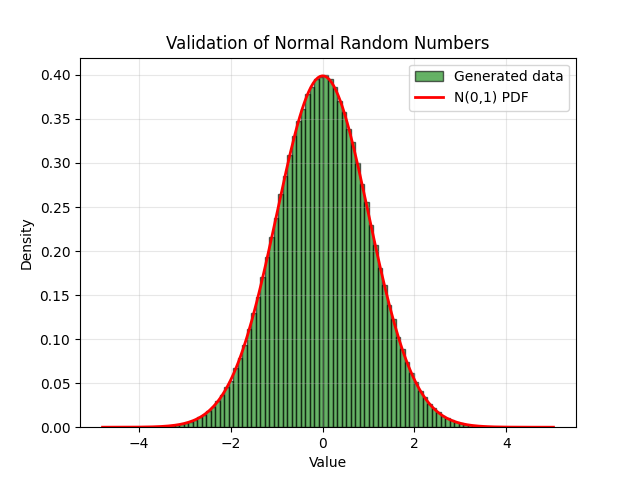
Validation of the generated normal distribution.
Listing 3: A test program, also serve as a simple example.
// test.cpp
#include "header_files/cpu_timer.hpp" // for CPU_timer::CPUTimer
#include "header_files/random_number.hpp" // for namespace random_number_generator

#include <algorithm> // for std::generate, std::for_each
#include <cstddef> // for std::size_t
#include <execution> // for std::execution::seq, par, unseq, par_unseq
#include <iostream> // for std::cout
#include <numeric> // for std::accumulate, std::reduce
#include <vector> // for std::vector; 用 std::array 会栈溢出


int main()
{
    cpu_timer::CPUTimer timer;

    random_number_generator::RandNormal rng {}; // 像定义变量一样定义一个随机数生成器对象 r
    // rng.seed(4638, 1169, 5752, 9876);
    std::cout << rng() << "  " << rng() << "\n"; // 通过 function call () 访问随机数
    std::cout << "Current value = " << *(rng.get_current_value()) << "\n"; // 查看当前随机数值

    rng.reset(); // 等价于 r.seed(r.get_current_seed());

    constexpr std::size_t N = 1000'0000;
    std::vector<double> v(N, 0.0);
    std::generate(std::execution::par_unseq, v.begin(), v.end(), [&]() {return rng();}); // 使用 Lambda 表达式做谓词,批量向 v 中生成随机数
    std::cout << v[0] << "  " << v[1] << "\n"; // 通过 function call () 访问随机数

    double mean = std::reduce(std::execution::par_unseq, v.begin(), v.end(), 0.0) / double(N);
    std::for_each(std::execution::par_unseq, v.begin(), v.end(), [=](double& x) { x -= mean; x *= x; }); // v 的每一个元素都减去 mean,然后平方
    double sample_var = std::reduce(std::execution::par_unseq, v.begin(), v.end(), 0.0) / double(N - 1);

    std::cout << "\nMean = " << mean << " == " << rng.get_sample_mean() << "\nSample var = " << sample_var << " == " << rng.get_sample_variance() << "\nNote that \"==\" needs reset().\n";

    std::cout << "CPU time: " << timer.elapsedNanoseconds() << " ns\n";

    return 0;
}
Listing 4: Compare with Python numpy.
# test.py
# It turns out that the Python numpy code is approximately of same performance as the -O2 optimized C++ code,
# which is expected because numpy is implemented in C.
import numpy as np
import time

def main():
    # 开始计时(CPU时间)
    t0 = time.process_time()

    N = 1000_0000
    print(f"Statistics of {N} normally distributed doubles in [0, 1):")
    # 生成服从 N 个标准正态分布的随机数
    data = np.random.randn(N)

    # 计算样本均值和样本方差(无偏估计,ddof=1)
    mean = np.mean(data)
    variance = np.var(data, ddof=1)

    print(f"Mean: {mean}")
    print(f"Sample variance: {variance}")

    # 结束计时
    t1 = time.process_time()
    elapsed_ms = (t1 - t0) * 1000
    print(
        f"CPU time: {elapsed_ms:.2f} ms"
    )  # 保留两位小数

if __name__ == "__main__":
    main()
Bibliography
- [1] 小海哥哥de, “C++11 生成随机数:std::random_device、std::mt199937 和 std::uniform_int_distribution.” Accessed: Aug. 18, 2026. [Online]. Available: https://www.cnblogs.com/xiaohaigegede/p/17782454.html
- [2] N. ChenMiaoi, “std::random 随机数库.” Accessed: Aug. 18, 2026. [Online]. Available: https://chenmiaoi.github.io/modern_cpp/standards/cpp11/random.html
- [3] B. Stroustrup, A Tour of C++, 3rd ed. Addison-Wesley Professional, 2023.
- [4] “C++ Reference.” Accessed: Aug. 18, 2026. [Online]. Available: https://cppreference.com/