On the monochromatic plane electromagnetic waves
Notes on the monochromatic plane wave and its polarization.
Ref: Xiong-Jun Liu (刘雄军)'s lecture notes at Peking University, 2023 Autumn.
Plane waves
Work in geometrized Gaussian unit ststem, Maxwell equations are
Eq. (1)
wave equations are
Eq. (2)
Properties of plane waves
- Def (plane wave) A plane wave is a solution to the wave equation that propagates along a fixed direction. A plane wave propagating along the direction is of the form
From we shall have
Eq. (3)
where is the derivative of w.r.t. its argument Now
Eq. (4)
so
Eq. (5)
The static magnetic field is of no interest since we are considering time-dependent waves. Thus
Eq. (6)
Similarly, drop another static field, gives
Eq. (7)
- Prop (plane wave)
- Remark The propertity will not hold in general in media where the charge density is not zero, whereas always holds.
Monochromatic plane waves
- Def (monochromatic wave) A monochromatic wave is a solution to the wave equation that has a definite frequency, so that its time dependence is of sinusoidal form.
A monochromatic plane wave is of the form
Eq. (8)
where Since the Maxwell equations are linear, we could just work in the complex notation11 Extra attention is needed when dealing with non-linear quantities, such as the energy density which is quadratic in the fields. with the understanding that we take the real part to get the physical quantity. Thus we simply write
Eq. (9)
- Prop (monochromatic plane wave)
Polarization of a monochromatic plane EM wave
For a monochromatic plane EM wave, since we could write
Eq. (10)
where while are orthonormal and are both orthogonal to
WLOG set then
Eq. (11)
where and is the phase difference between and
If we fix a value of (e.g. ), then the end point of the vector
Eq. (12)
will in general depict a ellipse in the plane
Eq. (13)
It is in this sense that the monochromatic plane wave is elliptically polarized.
Linear polarization
- Def (linear polarization) A monochromatic plane wave is said to be linearly polarized, if the direction of its electric field does not change, that is, if the ellipse in Eq. (13) degenerates into a straight line.
Using Eq. (11), a wave is linearly polarized if one of the following conditions holds:
Note that the basis we used in Eq. (10) are linearly polarized.
Circular polarization
- Def (linear polarization) A monochromatic plane wave is said to be circularly polarized, if the ellipse in Eq. (13) degenerates into a circle.
Using Eq. (11), a wave is circularly polarized if and
For the vector
Eq. (14)
ratotes anticlockwise in the plane; this wave is said to be right-hand circularly polarized (labelled by ) and have positive helicity22 Positive helicity means that the ratotion is parallel to the direction of propagation. Indeed, the helicity, which is defined as the component of spin angular momentum along the direction of propagation, of the mode characterized by wave vector and polarization is given by where is the time-averaged total energy of the mode; this can be compared with the Planck formula in quantum mechanics In the transition from classical to quantum physics, the helicity of the EM field becomes the spin of the photon.. Likewise, the wave with is said to be left-hand circularly polarized (labelled by ) and have negative helicity.
It is sometimes convenient to expand in terms of circularly-polarized waves, rather than linearly polarized waves as in Eq. (10). Define
Eq. (15)
that is
Eq. (16)
Note that It follows from the orthonormality of that
Eq. (17)
The inverse transform is
Eq. (18)
that is
Eq. (19)
Stokes parameters
The magnitude and phase information is sometimes expressed in terms of the so called Stokes parameters which are defined by (using the convensions and notations in Eq. (11))
Eq. (20)
Note that
Eq. (21)
The parameter characterizes the intensity of the wave, while characterizes the amount of polarization versus polatization; the third independent parameter, either or , characterizes the phase difference between the and polarized waves.
Prop (characterization of linear/circular polarization)
- Linear polarization corresponds to
- circular polarization corresponds to
Doppler effect
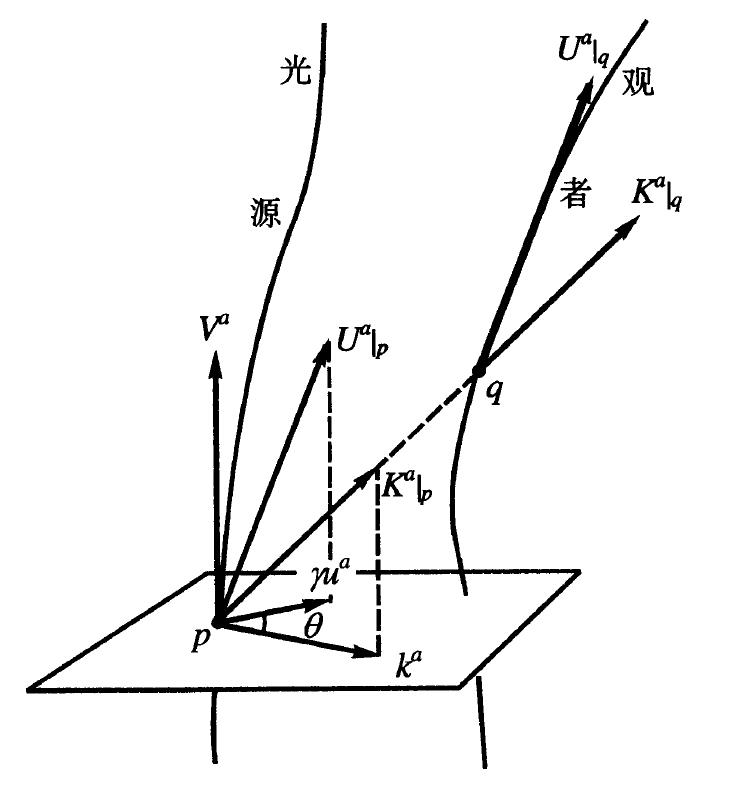
The world lines of the observer and the illuminant (light source) are both time-like. Assume that at spacetime point the illuminant whose 4-velocity is in abstract index notation, emits a monochromatic plane wave (at least in the geometric optics approximation sense) with 4-wavevector which is received at spacetime point by the observer whose 4-velocity is
Note that the angular-frequency measured by the illuminant at emitting is
Eq. (22)
and by the observer at receiving is
Eq. (23)
Since the Minkowski space is flat, can be can be identified with the vector via the global parallelism; from now on it is understood that all the calculations are done at
Let then
Eq. (24)
where is the projection of on the “space plane” perpendicular to Also
Eq. (25)
thus
Eq. (26)
Let be the angle between and and note that the result is written
Eq. (27)
where Note that is just the 3-velocity of the observer relative to the illuminant.
Non-relativistic limit of the Doppler effect
In this subsection, SI units is used.
For the light waves,
Eq. (28)
For other non-relativistic waves, the Doppler shift is most easily derive from the Galilean transformation.
Since the wave equation is invariant under the Galilean transformation, the plane wave phase is also invariant. Since in Newtonian mechanics, the concept of the length is absolute, the wave-length33 The wave-length is defined as the distance between the two material points (连续介质力学中的物质点) whose phase difference is and thus the wave-vector is Galilean invariant. Thus, under the Galilean transformation the angular-frequency transforms according to
Eq. (29)
where is the angular-frequency measured by the illuminant and by the observer, is the velocity of the observer relative to the illuminant.
- In space data analysis, let and be the angular-frequency of the wave and the bulk velocity of the plasma as observed by the spacecraft, respectively, then the angular-frequency in the plasma frame is
Electrostatic waves
The electrostatic field satisfies the equations
Eq. (30)
from which we derive the Fourier transform
Eq. (31)
In particular, the electrostatic field is longitudinal (instead of transverse)
When coupling to the matters (such as plasmas), it is possible for an electrostatic pertubation to propagate through the system; this is an electrostatic wave.
If the coupling is linear, then the mode characterized by wave vector evolves as (let be the dispersion relation which encodes the linear interaction of the electric field and the matter)
Eq. (32)
where is determined by solving the linear system (including boundary and initial conditions). This is sometimes referred to as the “plane wave ansatz.” Note that if the coupling is non-linear (as is generally the case), then the most general solution need not possess a monochromatic plane wave form (although we could always try to search for solutions of this form).44 The essence of the “plane wave ansatz”, or the “superposition principle” in linear systems, is two fold. On the one hand, the physical quantity under consideration can be decomposed into Fourier modes — we can always do this with aid of the mathematical Fourier theory. On the other hand, each Fourier mode evolves independently, and there is no interaction between any two of the modes — this is a consequence of linearity. Note, however, that if there exist non-linear phenomena, then different Fourier modes will indeed couple and cannot be solved independently. In such systems, for example, a pertubation with angular-frequency might excite frequency multiplications